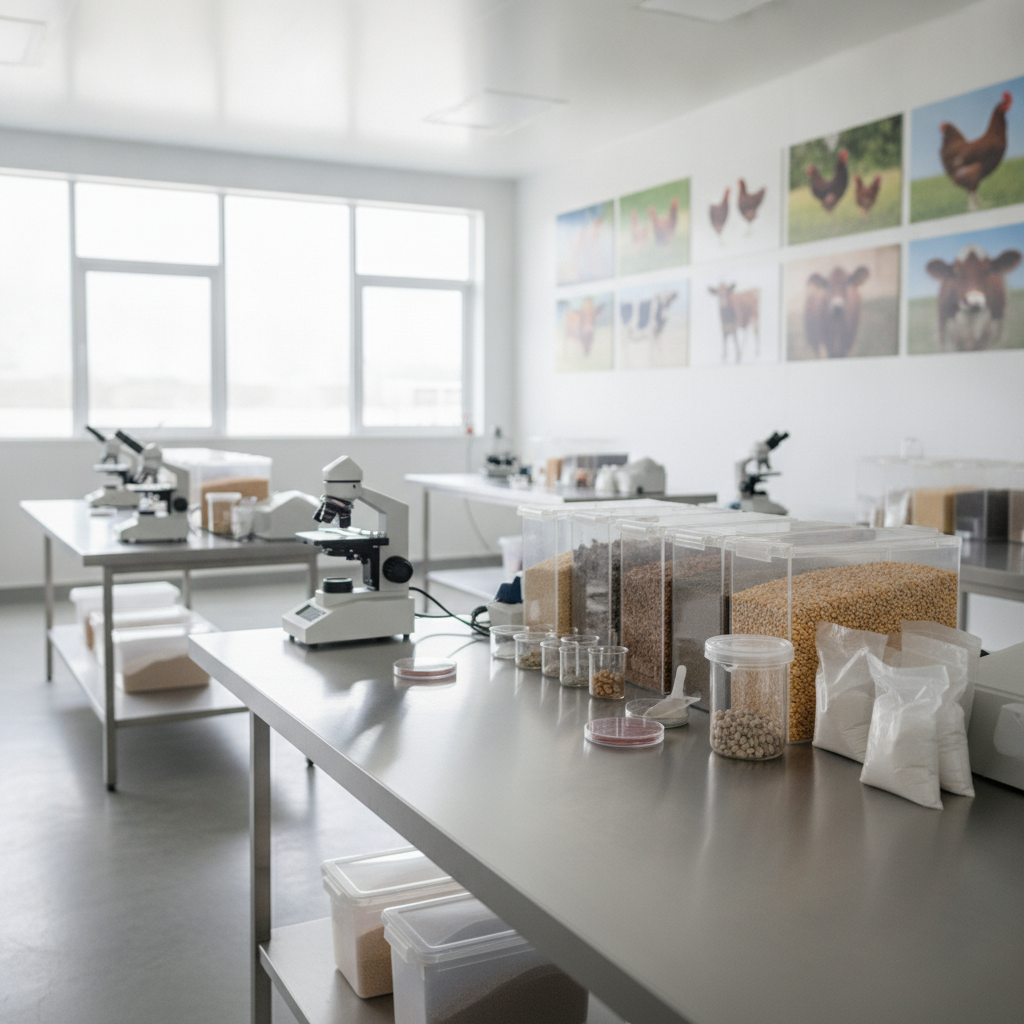
Feed additive selection is the disciplined matching of a stated performance goal to a category that actually fits your species, life stage, regulatory markets in the United States and Canada, supply reliability, evidence quality, and plant handling. This feed additive selection guide shows FFIB’s sourcing-led checks that prevent lab wins from failing at commercial scale.
By Food & Feed Ingredients Biz (FFIB) • Last updated: 2026-07-13
Summary
A practical feed additive selection guide ties goals to categories, then stress-tests regulatory fit, origin reliability, evidence quality, and plant handling. Below is a stepwise workflow we use at FFIB to help North American nutrition teams move from hypothesis to a run-ready, auditable spec without surprises.
- Audience: Nutrition leads, formulators, QA/RA, procurement, and plant managers.
- Scope: Poultry, swine, ruminants, equine; technical and functional additives.
- Flow: Goal → category → approvals → supply → evidence → formulation/scale-up.
- FFIB tools: Ingredient portfolio access, documented vendor vetting, spec alignment, and compliant logistics.
- Result: Faster decisions that hold up in audits and run cleanly on the line.
What a Feed Additive Selection Guide Actually Needs to Cover (and What Most Miss)
Good selection guides don’t stop at “which category.” They force-check approvals, origin, potency stability, carrier behavior, and blendability at real plant speeds. We’ve seen promising additives fail for avoidable reasons—usually a spec, carrier, or logistics detail that no one tested early.
Here’s what generic lists gloss over and why it matters on a Tuesday morning in your premix room:
- Carrier behavior matters: A hygroscopic carrier that cakes at 65% RH will choke your micro bin. We’ve seen yeast postbiotics that looked great on paper but collapsed a premix line in summer humidity.
- Potency at intake, not shipment: Heat-sensitive probiotics shipped without temperature control can land 1–2 logs down. Intake re-test prevents ghost dosing.
- Spec changes mid-batch: A supplier swapping carrier mid-lot can change bulk density and screw up micro-dosing. We require change-control notices and verify density before release.
- Approvals ≠ claims: Permitted use is not the same as label flexibility. Align claims language with documented status for the United States and Canada before creative copywriting.
- Evidence must match the spec: If the study used 500 FTU/kg phytase to release ~0.10–0.15% available phosphorus, buying a different carrier or potency changes outcomes.
FFIB bakes these “boring” checks into sourcing, importing, and distribution so trials don’t die at commissioning.
Step 1 — Define the Performance Goal Before Choosing a Category
Pick one outcome and one KPI. Write the hypothesis, set the baseline, and agree on a target delta. Goals like “improve FCR by 2–4 points in broilers” or “raise milk fat by 0.1 percentage point” keep category choices and dose decisions grounded.
- Concrete goals we use:
- Broilers: FCR –0.02 to –0.04; coccidial vaccine take maintained; footpad score improvement.
- Layers: +1–2% shell strength; +0.5 g/egg mass; keel health maintained.
- Grow-finish swine: +20–30 g/day ADG; feed conversion –0.03; lower post-wean scour days.
- Dairy: +0.1–0.2% milk fat; +0.05–0.1% milk protein; maintain DMI.
- Context to log: Diet matrix (e.g., high wheat, high phytate), life stage, health program, known constraints (pellet temp >85°C, premix micro-doser ±10 g resolution, ambient RH 60–70%).
- Acceptance criteria: Define success and stop-loss upfront so you don’t “move the goalposts” mid-trial.
Opinion: if you have three goals, you don’t have a goal. Stack-rank and run them in order—your trial budget will thank you.
Step 2 — Match Additive Category to Species, Life Stage, and Production System
Choose categories that fit biology and ration. Enzymes shine in cereal-heavy poultry/swine diets; buffers and rumen modifiers are ruminant tools; plant extracts can be cross-species but dose, carrier, and solvent residues matter. Avoid kitchen-sink blends that underdose actives.
| Goal | Category examples | Species/life stage fit |
|---|---|---|
| Improve feed efficiency | Xylanase 16,000–24,000 BXU/kg; Phytase 500–1,000 FTU/kg; emulsifiers 250–500 g/MT | Poultry, swine; larger wins in high-NSP/high-phytate diets |
| Stabilize gut health | Probiotics/postbiotics 100–500 g/MT; yeast derivatives 250–1,000 g/MT; targeted plant extracts 100–300 g/MT | All species; watch carrier and heat sensitivity |
| Support milk fat/protein | Buffers 0.5–1.0% diet; rumen-protected fats 200–400 g/cow/day; protected amino acids per balancing model | Ruminants; align with forage NDF and DCAD |
| Mycotoxin risk | Binders 1–2 kg/MT; enzymatic modifiers; antioxidants 100–300 g/MT | All species; match to toxin profile (DON vs. aflatoxin vs. fumonisin) |
| Shell/egg quality | Coarse calcium timing; vitamin D3; chelated trace minerals 20–60 ppm | Layers; coordinate with particle size and feeding schedule |
Our take: broad-spectrum mycotoxin binders are oversold for DON. If DON drives your risk, use a modifier plus antioxidant stack; a binder alone often won’t protect gut integrity. Want a short list by species and goal? Browse FFIB’s product portfolio.

Step 3 — Evaluate Regulatory Status and Market-Specific Compliance
Confirm permissibility and labeling for your species and claims in the United States and Canada before trials. Collect a tight document pack and align claims language with status. Get QA/RA sign-off early to avoid reformulations late in the process.
- Define markets: United States, Canada, or both; if you export finished feed, extend the check to destination markets.
- Collect documents: CoA, TDS, SDS, allergen and GMO statements, label drafts, and species-specific approvals or letters of opinion where applicable.
- Packaging/impurity controls: For sensitive actives, review contact-material risks and impurity controls; this E&L overview for FDA is a helpful risk framework.
- Traceability: Map lot coding into your ERP and set change-control expectations with the supplier.
We maintain templated vendor packs and a certifications library so your internal review takes days, not weeks.
Step 4 — Assess Ingredient Origin, Supply Reliability, and Sourcing Flexibility
Reliable supply beats perfect specs. Probe origin, seasonality, lead times, and second-source plans. Build safety-stock rules and logistics controls for heat- or humidity‑sensitive actives. The best additive is useless if you can’t get it on time, at potency.
- Origin reality: Botanical extracts shift with harvest. Specialty chemicals can bottleneck at a single upstream intermediate. Lock variability limits and retain COA/identity testing on intake.
- Lead times/MOQs: Align to your production cadence; pre-book during peak seasons and holidays.
- Alternates: Pre-approve an equivalent spec or carrier to prevent reformulation under pressure.
- Temperature and moisture: For probiotics/postbiotics, require temperature control and data logging. We’ve rejected arrivals that lost a full log in transit.
- Border checks: We’ve intercepted shipments where the COA potency unit didn’t match the label claim—stopping a customs hold before it hit your dock.

FFIB’s North American base plus global partnerships means we can pivot—reroute, rebook, or switch to a pre-qualified alternate—without derailing your formulation timeline.
Step 5 — Validate with Clinically Supported Evidence, Not Just Label Claims
Insist on peer-reviewed or well-controlled field data that match your species, ration, and dose. Verify the commercial spec equals what was tested—same active, potency, and carrier. Set a decision rule so one lucky pen doesn’t drive a purchase order.
- What “good” looks like:
- Phytase 500–1,000 FTU/kg: typically releases ~0.10–0.15% available phosphorus; FCR improvements of ~1–2 points in broilers when matrixed correctly.
- Xylanase 16,000–24,000 BXU/kg in wheat/corn-wheat diets: often yields 2–4 point FCR gains and drier litter.
- Organic acids 2–6 kg/MT: expect pH shifts and pathogen pressure reduction in nursery pigs when managed with waterline hygiene.
- Translatability check: If the study ration is corn-soy and you’re running wheat-DDGS, calibrate expectations or don’t run the trial.
- Analytical discipline: Borrow human-health rigor on spec control; this primer on FDA characterization is a useful mindset for actives and impurities.
- Decision rule: Predefine a win (e.g., FCR –0.02 with no mortality uptick) and a stop-loss before you sample.
Opinion: skip “fairy dust” levels. Under-dosing to make room in a crowded premix is how good ideas die.
Step 6 — Align with Formulation Constraints and Scale-Up Requirements
A strong additive must run on your line. Check premix compatibility, micro-doser resolution, pellet heat/shear tolerance, and post-pellet options. Lock packaging and change-control before the first truck ships to avoid mid-run surprises.
- Processing fit: If pelleting exceeds ~85°C for 30–60 seconds, assume unprotected enzymes and many probiotics will suffer. Consider coating or post-pellet application.
- Premix handling: Aim for consistent bulk density; address segregation risk; treat hygroscopic carriers that cake above ~60–65% RH.
- Micro-dosing: For ppm-level actives, target micro-doser accuracy within ±5–10 g/MT. If not feasible, use pre-carried versions.
- Impurity thinking: Risk-screen for nitrosamines and other impurities; this nitrosamine overview can sharpen SOPs even for feed.
- Documentation: CoAs, stability curves at your storage temp, and shelf-life controls belong in the spec—before you scale.
Send us your plant constraints and desired inclusion; we’ll shortlist specs that won’t fight your equipment and climate. Use the FFIB Product Enquiry Form.
Where FFIB Fits Into Your Selection Process
FFIB is a North American B2B partner for sourcing, importing, and distributing science-backed ingredients. We turn “this looks promising” into “this runs cleanly on our line,” from ideation to scale-up, across poultry, swine, ruminants, and equine programs.
- Shortlists that matter: Enzymes, plant-based extracts, probiotics/postbiotics, amino acids, binders, emulsifiers, and specialty actives—filtered by your diet matrix and plant limits.
- Regulatory alignment: Documented packs and claim checks for Canada and the United States, built to speed QA/RA sign-off.
- Sourcing without drama: Global manufacturer collaborations, second‑source planning, and temperature-controlled logistics when required.
- Real fixes we’ve made: Swapped a hygroscopic carrier that was caking premix; re-routed a heat‑sensitive probiotic with data‑logged transit; blocked a border hold after catching a COA/label unit mismatch.
- Next steps: Start a scoped request via the enquiry form, explore our portfolio, review certifications, or contact our team. For cross-over projects, our API sourcing guide mindset helps when animal and human health standards intersect—see the FFIB blog.
FAQ
These are focused answers to recurring buyer questions from nutrition, QA/RA, and procurement teams selecting feed additives in North America.
What’s the fastest way to narrow additive options?
Pick one KPI and baseline, then drop any category that isn’t approved for your species in the United States or Canada. Next, exclude specs you can’t source reliably at dose. FFIB can run this triage against your diet matrix and plant limits in a single review call.
How do I confirm supplier evidence really applies to my diet?
Check species, life stage, diet type, environment, and dose. Verify the tested material equals the commercial spec—same active, potency, and carrier. Favor peer-reviewed work and multi-site field trials. We benchmark dossiers and flag gaps before you order samples.
What if the best additive on paper won’t run on my line?
Change the carrier, move dose to a different premix, or switch to a post‑pellet application. Sometimes a close second choice with strong blendability beats the “winner” that clogs your micro-doser. FFIB sources tailor‑made options aligned to your plant.
Can human‑health QA practices improve feed additive programs?
Yes. Structured documentation, change‑control, impurity risk screens, and intake re‑testing reduce surprises. We work across human and animal health ingredients and bring that discipline to feed without adding red tape.
Key Takeaways
- State one KPI goal and lock dose/spec before sampling—then test.
- Match category to biology and ration; avoid blends that underdose actives.
- Regulatory fit, origin reliability, and potency on intake are non‑negotiable.
- Evidence must match your diet and the exact commercial spec you’ll buy.
- Plant handling (heat, RH, micro‑dosing) makes or breaks promising additives.