
Nutraceutical ingredient sourcing is the verified, end-to-end process of qualifying, procuring, importing, and distributing raw materials for human and animal health products. It aligns suppliers, specifications, documentation, and logistics so production stays compliant and on time in the United States and Canada.
By Food & Feed Ingredients Biz (FFIB)
Last updated: 2026-07-12
Overview
Nutraceutical ingredient sourcing reduces risk by locking specifications, COA methods, and import logistics before purchase orders. Brands gain faster approvals, fewer reformulations, and steadier supply when supplier capability, documentation, and temperature control are aligned from sample to scale.
You’ve been waiting three weeks for a COA that finally lands—only to learn the assay method doesn’t match your spec. That’s not a vendor problem; that’s a sourcing process problem. Our approach makes issues like this rare by aligning requirements early and testing them against real shipments.
- Scope: Botanical extracts, nutraceutical actives, APIs, specialty chemicals, feed additives.
- Markets: United States and Canada, with global manufacturer relationships.
- Support: Custom formulations, co-development, and clean-label alignment.
- Start here: Outline needs in our Product Enquiry Form.
What Nutraceutical Ingredient Sourcing Actually Involves (and Where It Goes Wrong)
Effective sourcing synchronizes specs, documentation, audits, and logistics before the first PO. Most failures stem from method mismatches on COAs, gaps in traceability, misclassified imports, or unstable lead times—avoidable with pilot lots, clear quality agreements, and a secondary supply plan.
Core steps that keep launches on track
- Define specs: Assay windows and tolerances (e.g., curcuminoids ≥95% by HPLC, ±2%); contaminants, particle size, moisture, carrier limits.
- Pre-qualify suppliers: GMP evidence, audit history, change-control, sustainability claims with proof.
- Documentation pack: COA template, TDS, SDS, allergen/GMO/vegan statements, stability, manufacturing flowchart.
- Pilot lots: Three consecutive lots to validate assay, organoleptics, and logistics handling.
- Quality agreement: Deviations, CAPA, re-test timing, and notification triggers.
- Import readiness: HS code, country-of-origin, labeling; cold-chain or hazardous flags confirmed with carriers.
- Scale strategy: Forecast windows, buffer stock (often 15–30% for volatile items), alternate plants.
Where teams lose time—and how to fix it
- COA method mismatch: Don’t accept a quote until the COA method is locked in writing. We standardize method-fit during enquiry, then verify in pilots.
- Spec ambiguity: “High polyphenols” is vague. We set measurable targets (e.g., total polyphenols ≥35% ±3% by Folin–Ciocalteu) and tie them to label claims.
- Reactive importing: Customs holds burn calendar days. We coordinate permits and carrier acceptance before sampling—especially for temperature-sensitive or hazardous items.
- Price-first negotiation: We advise clients to defer price talks until three passing COAs from the same plant are in hand. One failed lot can erase a year’s savings.
Field note: A ruminant premix team targeted catechin/epicatechin markers in a green tea extract. Seasonal swings were ±6–8%. We dual-sourced across hemispheres, adjusted extraction solvent ratios with the manufacturer, and locked a window at ≥40% total catechins ±3%. The client maintained supply through a drought year without a single reformulation.
The Sourcing Criteria That Matter Most to Formulators and Contract Manufacturers
Build for repeatability: unambiguous specs, matching COA methods, verified GMP, and realistic logistics windows. Dual-source critical SKUs and insist on change-control discipline so label claims and batch records survive real-world variability.
Non-negotiables for commercial runs
- Spec clarity: Actives and markers with allowable variability; define carriers and residual solvents.
- Method integrity: HPLC/GC/ICP-MS aligned to the spec—not “closest available.”
- Contaminant control: Pesticides, heavy metals, PAHs, mycotoxins, residual solvents.
- GMP and audits: Certificates, audit summaries, corrective actions.
- Logistics realism: Cold-chain vs. ambient, pallet patterns, moisture control, re-test dates.
- Regulatory fit: U.S. supplement rules vs. Canadian NHP/Feed requirements documented up front.
Operational stances that save launches
- Three-lot rule: Validate performance and paperwork across three lots before finalizing supply terms.
- Buffer stock: Hold 15–30% on high-variability botanicals; review quarterly.
- Secondary source: Qualify one backup per critical SKU; test at least one lot per year.
- Method drift watch: Reconfirm analytical methods whenever plants or carriers change.
FFIB packages these checkpoints in our Product Enquiry Form and provides documentation structure aligned with your QA workflow. For certifications and standards, see our certifications page.
Botanical Extracts, APIs, and Specialty Chemicals — Why Each Category Demands a Different Sourcing Approach
Treat each category as its own track. Botanicals require agricultural traceability and marker standardization; APIs require GMP rigor and impurity profiling; specialty chemicals hinge on hazard class and handling. Specifications, test methods, and logistics must reflect those realities.
| Category | Spec Focus | Critical Tests | Logistics | Typical Use | FFIB’s role |
|---|---|---|---|---|---|
| Botanical extracts | Marker compounds, solvent system, seasonality | HPLC markers, pesticides, PAHs, mycotoxins | Ambient/cool, moisture and light control | Human nutraceuticals; species-specific feed | Standardize markers, dual-hemisphere supply, and three-lot pilot before scale |
| APIs | Assay, impurity profile, residual solvents | Impurities (e.g., ICH-style), LC/GC-MS, particle size | Controlled; often cold-chain and chain-of-custody | Clinical nutrition, vet Rx, R&D | GMP verification, impurity method fit, retest protocols, import planning |
| Specialty chemicals | Purity, hazard class, stabilizers/antioxidants | SDS alignment, heavy metals, stability | HAZMAT handling; segregation; temperature flags | Processing aids, encapsulants, carriers | Carrier selection, DG carrier acceptance, packaging and pallet patterns |
Explore materials in our product portfolio. If you’re a manufacturer seeking partnership, see our vendor partnership form.
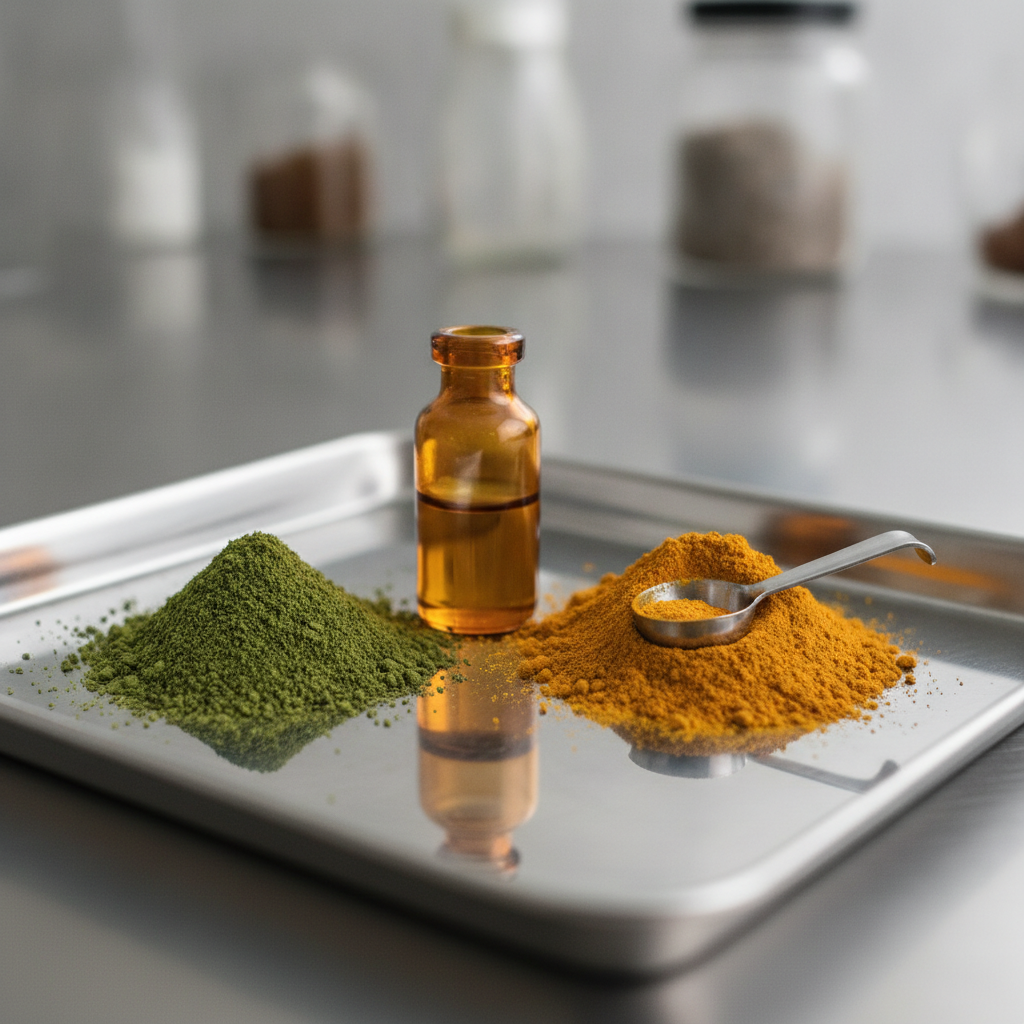
Tailor-Made vs. Off-the-Shelf: When Custom Formulation Changes the Sourcing Model
Choose tailor-made inputs when catalog items can’t meet label claims, sensory targets, species performance, or clean-label constraints. Customization sets the spec first, pilots three lots, then locks documentation and logistics—reducing reformulations after launch.
Good reasons to go custom
- Label claim requires a marker ratio (e.g., 65:35 curcuminoids) not met by catalog items.
- Species performance data demands tighter ranges for actives or particle size.
- Clean-label excludes certain carriers or residual solvents.
- Sustained-release or taste-masking profile is needed for compliance.
When not to go custom
- Claims can be met with existing items plus blending or encapsulation.
- Volume is too low to justify MOQs and change-control overhead.
- Regulatory path is uncertain—prove classification first, then customize.
Our stance: Prove repeatability before price and before customization. We often pilot three catalog lots first; if they miss consistent targets, we shift to tailor-made specs and co-develop with the manufacturer.
Regulatory and Import Considerations You Must Resolve Before Committing to a Supplier
Classify the ingredient, confirm HS code and origin, and align analytical methods to your spec before sampling. Validate carrier acceptance for cold-chain or hazardous materials. Missteps here trigger customs holds, shelf-life loss, and repeat testing.
Documentation and testing alignment
- Packaging compatibility: Manage extractables/leachables risk for sensitive actives; see this overview of extractables & leachables guidance.
- Impurity risk (APIs): Map nitrosamine risks and method readiness; a concise nitrosamine risk guide outlines practical steps.
- Supply resilience: Diversify lanes and control temperature; industry analysis on pharma supply chains highlights proven levers.
Import and logistics checkpoints
- Confirm HS code, tariff status, and origin statements before sampling.
- Verify HAZMAT classification and carrier acceptance early.
- For cold-chain: add temperature monitors and set re-test windows tied to transit time.
- Align pallet patterns, packaging, and labels to your receiving SOPs.

Tip: Keep a shared register of permits, SDS versions, and quality agreements. Update it with every change-control event so operations and QA stay synchronized.
How FFIB Structures Nutraceutical Ingredient Sourcing for Human and Animal Health Clients
We translate your label and performance goals into measurable specs, then match vetted manufacturers, validate three lots, and harden logistics. The result is faster approvals and steadier supply across U.S. and Canadian markets.
- Discovery: Application, label claims, species/market, regulatory target.
- Spec drafting: Assay windows, markers, contaminants, carriers, particle size.
- Manufacturer match: Global partners vetted against audits and capabilities.
- Pilot lots: Three-lot validation with COA and performance checks.
- Quality agreement: Deviation/CAPA terms, retest timing, method change rules.
- Import plan: HS code, permits, labels, cold/ambient routing.
- Scale-up: Forecast, buffer stock, alternate plants and lanes.
Want a fast qualification path? Request a documentation pack and sample plan via our enquiry form, review certifications, or connect through contact. Manufacturers can reach us via the vendor partnership form.
Questions to Ask Any Ingredient Sourcing Partner Before Signing
Pressure-test process maturity. Ask about COA methods, deviation history, change-control, and secondary sources. Solid partners share anonymized CAPA examples and align documentation timelines with your launch calendar.
- Which COA methods will you use and why are they fit for our spec?
- Can you share a recent deviation and CAPA example (anonymized)?
- How do you manage secondary plants and annual revalidation?
- What import documents and permits will be ready before PO?
- How do you align U.S. supplement vs. Canadian NHP/Feed rules?
- What’s your notification timing for method or process changes?
Benchmark expectations with established suppliers like Prinova, Barentz North America, Univar Solutions, AIDP, and Glanbia Nutritionals. FFIB differentiates with dual human+animal health coverage and hands-on co-development for tailor-made specs.
Key Takeaways
Lock the spec and method fit, validate with three lots, and finalize logistics before price. Treat botanicals, APIs, and specialty chemicals as distinct tracks, and maintain buffer stock with a qualified backup source.
- Align specs, COA methods, and import logistics before the first PO.
- Botanicals, APIs, and specialty chemicals require distinct sourcing playbooks.
- Use the three-lot rule and keep 15–30% buffer on variable botanicals.
- Qualify a secondary source for every critical SKU.
- FFIB integrates sourcing, importing, distribution, and co-development across the U.S. and Canada.
FAQ: Nutraceutical Ingredient Sourcing
These concise answers address the practical questions buyers and formulators ask most about specs, documentation, and timelines in nutraceutical ingredient sourcing.
What documents should I request before approving a new ingredient?
Request a standardized COA, TDS, SDS, allergen and contaminants statements, stability data, manufacturing flowchart, and packaging/labeling summary. For APIs, include impurity profiles and defined retest dates. Tie updates to a written quality agreement and change-control.
How do botanicals differ from APIs in sourcing?
Botanicals demand agricultural traceability and marker standardization to manage variability. APIs require GMP rigor, impurity profiling, and tighter handling controls. Both need method-to-spec alignment and import readiness, but the test suites and logistics differ.
When should I consider a tailor-made ingredient?
Choose custom inputs if catalog materials can’t meet label claims, sensory targets, species performance data, or clean-label constraints. Set a precise spec, validate through three pilot lots, then lock documentation and logistics for scale.
Can one partner support human and animal health sourcing?
Yes. FFIB sources botanicals, nutraceutical actives, APIs, specialty chemicals, and feed additives across the United States and Canada, with co-development and regulatory alignment for both markets.